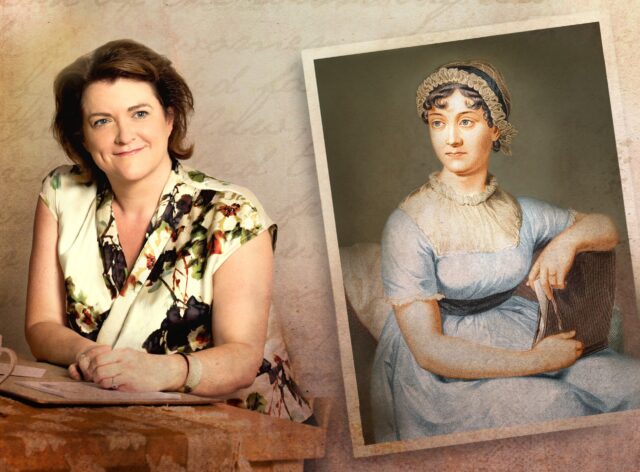
Impossible, when meeting Jane Austen’s fifth great-niece, not to examine her face to see if she resembles pictures of her famous ancestor. While I find no real resemblance between Jane Austen and Caroline Jane Knight, Caroline resembles her relative in another way: Like Jane, Caroline has a lively, cheerful disposition, and has no trouble carrying on a witty conversation.
I am chatting with Caroline in Colonial Williamsburg, a living history museum in Virginia, where she is scheduled to speak in a few hours and sign copies of her book, Jane & Me: My Austen Heritage. Over the next hour, I learn surprising facts about Jane Austen and her family.
While there are currently some 2,500 descendants of Jane’s six brothers around the globe, Caroline and her brother Paul are the only ones who grew up just 400 yards from the cottage in Chawton, England where Jane, her sister Cassandra, and their mother lived during the last eight years of Jane’s life—years that were both happy and productive.
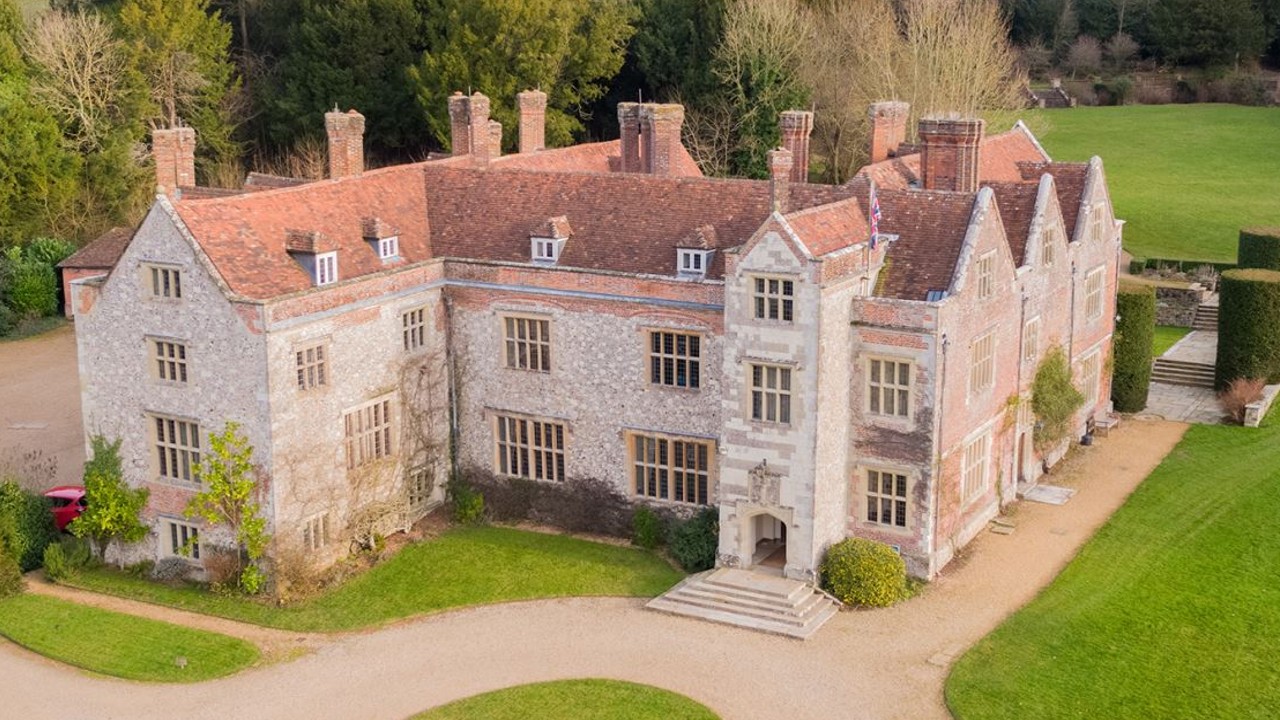
Caroline and Paul, their parents, grandparents, and assorted other relatives shared Chawton House, an Elizabethan stately home inherited by Jane Austen’s brother Edward in 1783. Edward was adopted by childless (and wealthy) relatives, Thomas and Catherine Knight, who asked only that Edward change his name from Austen to Knight.
As children, Caroline and Paul wandered over the estate, fed the pheasants, picked apples and blueberries for pies, pulled weeds from the vegetable garden, and imagined Jane enjoying the 2,500 acres of estate land and the house itself. As Jane wrote to her sister Cassandra in 1814, “I went up to the Gt. House between three and four, and dawdled away an hour very comfortably.”
Caroline’s parents frequently hosted community events, such as steeplechases, pheasant shoots, horticultural shows, point-to-point races, and charity fundraisers. Every summer, a ball was held in the Great Hall, and Caroline’s parents enjoyed inviting friends to dinner parties and lunches. During the Second World War, Chawton House sheltered evacuees fleeing enemy bombing in London.
When visitors came to tour Jane’s cottage, they often made their way up to the manor house to purchase the scones and cakes Caroline and her grandmother baked. If tourists dared to ignore signs reading “closed” and “private house,” and spread a blanket on the lawn to eat lunch, Granny would race out of the house waving her walking stick and order them to leave. There was, Caroline says, a hint of Lady Catherine De Bourgh in her granny.
Visiting Austen fans assumed that the Knight family was wealthy; they were shocked to learn that the young girl serving them tea and cake was not a servant, but an actual descendant of the Knight-Austen family. Hearing this, slightly too-friendly Americans often touched, grabbed, and hugged young Caroline, making her a bit wary of them.
Every December, as Christmas approached, Caroline and Paul tobogganed down the estate’s wide, snow-covered lawns, searched the grounds for the best boughs of holly, and draped home-made streamers in the Great Hall from one set of stag antlers to another. They eagerly awaited the arrival of extended family members, who shared Christmas dinner in the Great Hall, occasionally joined by bats flying near the ceiling.
After dinner, served on the same Wedgwood china on which Jane dined, they played Snap-Dragon, a game the family has enjoyed for centuries. They roasted chestnuts, warmed mulled wine in a fireside jug, and shivered over stories of a ghost called the Gray Lady, and a poltergeist, both of whom were said to inhabit Chawton House.
The house, Caroline remembers, “was rather unnerving when the lights were out: the dark, oak-paneled walls, the creaky floors, the stories of resident ghosts, and the many portraits of our ancestors with eyes that followed me as I walked past. I was easily spooked in my grandparents’ quarters at night.”
Caroline learned early the meaning of the word “entail”.
Caroline learned early the meaning of the word entail. When her grandfather died, the estate would go to her uncle, who could throw them all out if he wished, just as Elinor and Marianne Dashwood, characters in Sense and Sensibility, were thrown out of their home when their father died.
Caroline sympathizes with Elizabeth Bennet’s mother in Pride and Prejudice; she was right to worry about what would happen to her and her daughters when Mr. Bennet died. She notes that, while readers enjoy Mr. Bennet’s amusing comments, he is hardly an admirable character: He’s an irresponsible husband and father who failed to make any provision for his family. In that time and place, it was vitally important that daughters marry well and have homes of their own. Even then, if there were no sons, the wife could be rendered homeless by whomever inherited an entailed estate.
Sadly, Chawton House, which had been in the family for 400 years, was beginning to define the word derelict. The family fortune had petered out early in the 20th century. Both of Caroline’s parents had full-time jobs and raised additional funds by renting out rooms and selling Granny’s teas. Over the years, land and portraits were sold to pay the bills. But it simply wasn’t enough.
In 1987, when Caroline was seventeen, her grandfather, the fifteenth squire of Chawton, died, leaving the estate in financial ruin. The Knights were forced to sell their beloved home and move into a modest house—one that seemed claustrophobically small to Caroline.
Losing her home, and the security it represented, Caroline says, was a devastating blow, echoing the plight of every Austen character who was threatened with the loss of her home.
For years, Caroline had nightmares about walking the streets, homeless. She determined to become financially independent, “to be in control of my own destiny and not beholden to a wealthy husband,” as Jane Austen’s characters often were. She alone would decide where she would live. No one would be allowed to take her house, and money, away from her.
Inspired by Jane’s spirit of independence, Caroline left Chawton age 18 to build her own path. She took on a number of nannying jobs, and attended the University of North London, earning first-class honors in Marketing and second-class honors in Human Resource Management. She spent the next 25 years building a successful career as a business woman, CEO, and social entrepreneur, leading organizations globally.
By 2012, Caroline had relocated to Melbourne, Australia, where she lives today with her husband, a data analyst and horse trainer.
For two-and-a-half decades, Caroline was silent about her famous ancestor.
For two-and-a-half decades, Caroline was silent about her famous ancestor. Talking about her link to Jane Austen so would have brought up painful memories of the loss of Chawton House. Nor did she watch Austen films or documentaries, or read articles about Jane, in order to protect herself from a sense of loss.
But when her father called in 2017 to suggest Caroline take part in the bicentennial celebration of the publication of Pride and Prejudice, taking place in Melbourne, Australia, she decided to go. Her talk delighted her audience, and since then, Caroline has been invited to speak all over the world about her famous relative. Some 900 fans recently came to Baltimore, Maryland to hear her talk at an event sponsored by the Maryland chapter of the Jane Austen Society of North America.
***
Caroline has spent decades thinking about her aunt’s character, challenges, writings, and even her appearance. Nobody really knows exactly what Jane looked like, she says; Jane’s sister Cassandra once sketched her, but didn’t think much of the result. And the famous picture of her in the blue dress that decorates many of her books? “It’s a fake, prettified version” of the author, painted 53 years after her death, Caroline says.
The mystery of what Jane looked like is “part of the magic that maintains people’s interest in Jane Austen over a lifetime: a desire to know Jane, who is just out of reach,” Knight adds.
Readers often think they know the real Jane Austen through her letters, but . . .
Readers often think they know the real Jane Austen through her letters, but letters can be misleading. Certain matters may be discussed out of context, not meant to be taken seriously, or written to let off steam in a moment of anger, Caroline points out. “We don’t really know Jane’s feelings, even with her letters to guide us.”
Why, I asked, is Jane Austen’s work more popular than ever?
Part of the reason, Knight answers, is “the absolute genius and quality of her writing. Her works are simple and complex at the same time.”
Second, there’s the tremendous appeal of Jane herself. The author grew up in a lively, intellectual household that encouraged members to be intensely curious. Of the eight Austen children, “The family knew Jane was very special,” Caroline notes. “I think her life story is incredible.”
The many high-quality films of Jane’s novels—and about Jane herself—have also had an impact on the author’s twenty-first century popularity. “The films created a whole other way to enjoy Jane Austen,” and often inspire film-goers to read her books, Caroline observes.
When Caroline was growing up, visitors to The Jane Austen House Museum had read all six of the author’s novels. Today, many of them have not read a single one; they came to Chawton (often garbed in Regency gowns) because they loved the films, and wanted to learn more about the author.
Caroline has no objection to Austen fan fiction, such as a bestselling book titled Pride and Prejudice and Zombies, or the many “sequels” that focus on lesser Austen characters.
“I absolutely embrace it,” Knight says. “It gives readers who want to stay in Jane’s world a means of doing this.” Like the films, these books are new ways of approaching and exploring Austen’s own writings.
Was Jane Austen a feminist? Only in the sense that she would have thought women should have the same professional opportunities as men, Caroline says. She wrote to please herself and to make money.
One wonders: Would Jane Austen have been a different person had she been born in, say 1975 instead of 1775? As Caroline reminds us, Jane was a very private person, preferring to keep her identity as an author secret. Caroline cannot imagine her having social media accounts, going on promotional tours, turning up on Oprah, or letting fans take selfies with her.
What we do know is that she would not have let publishers, or her adoring public, push her around. When His Royal Highness, the Prince Regent, wrote to Jane suggesting that she write an historical romance about history of the house of Cobourg, Jane firmly turned him down. “I could not sit seriously down to write a serious Romance under any other motive than to save my life,” Jane told him in a letter. “No-I must keep to my own style & go on in my own Way.”
Jane has become the poster girl for an era
Today, thousands of online discussion groups celebrate Jane and her characters. “Jane has become the poster girl for an era,” Caroline observes. “We have Jane Austen balls, regency balls, Jane Austen merchandise. There’s even a Jane Austen action figure” (complete with a desk and quill pen). “If you attach Jane Austen’s name to something, such as a ball, it will sell out. And the continuous use of her name ups her profile.” More than 200 years after her death, Jane, Caroline concludes, has become a rock star.
When Jane’s face was chosen to appear on an English 10-pound note in 2017, it set off a new explosion of interest in all things Austen, as did the 200th anniversary of the publication of Pride and Prejudice in 2013, which was celebrated worldwide. Caroline realized that she could harness her link to Austen to pursue charitable endeavors.
As she pondered ways to do this, Caroline discovered that 100 million children across the globe are illiterate, with little possibility of being taught how to read. What could be a better way of honoring Jane, Caroline thought, than to use her name to promote literacy?
 Caroline launched The Jane Austen Literacy Foundation in 2014. One of its first projects was to purchase books for an indigenous community in a remote region of Australia. Today, more than 150 volunteers in 17 countries raise funds and promote Foundation activities. The charity has, Caroline says, “grown into more than I dreamed.”
More than 100,000 fans visit Jane’s former home each year. Americans used to make up the greatest number of visitors, but now, Japanese pilgrims outnumber them, followed by Chinese fans. Amusingly, Caroline says, when Japanese Janeites visit Chawton House, many of them sit briefly in every chair at the dining room table so they can go home and tell their friends they sat where Jane Austen sat.
Chawton House’s new owners spent many years restoring it, and the house now functions as a center for the study of early women’s writing from 1600 to 1830. It opened in 2016 to academics and researchers from around the globe who want to study the books, many of which are available nowhere else. The house is also open to the public.
As Jane’s 250th birthday approaches on December 16, many birthday parties will take place around the globe by enthusiastic Janeites. One of them will take place at Chawton House, which will hold a Regency-style Christmas celebration in Jane’s honor. Visitors will have a chance to create Christmas decorations, listen to stories, enjoy afternoon tea, watch a performance of “A Christmas Carol,” and wander through illuminated gardens.
As for Caroline Jane Knight, she has finally been able to leave the pain of the past behind. Home is now Melbourne, she says, but “I will always have an eternal connection with Chawton House, no matter where I live.”